Lynx Professional Grills are among the finest outdoor cooking appliances in the world. Built in California with commercial-grade 304 stainless steel, dual-tube brass burners, and ceramic briquette radiant technology, a Lynx grill is engineered to deliver restaurant-quality performance for 20 years or more. In Bradenton and Sarasota, Lynx grills are a fixture on the lanais and outdoor entertainment spaces of some of the Gulf Coast’s finest properties.
But a Lynx grill requires cleaning methods that most general-purpose cleaning services aren’t equipped to deliver. Using the wrong products, the wrong technique, or the wrong tools on a Lynx can permanently damage the stainless finish, void the warranty, and compromise the components that make the grill perform at its best.
What Makes Lynx Grills Different — and Why Cleaning Matters More
Ceramic Briquette Radiant System
Lynx’s signature ceramic briquette system provides even radiant heat distribution and natural smoke flavor. But ceramic briquettes accumulate grease and carbon over time — particularly in Florida’s humid climate. Cleaning requires careful removal, inspection, and either cleaning or replacement of the briquettes. Pressure washing or harsh alkaline cleaners will crack or degrade ceramic briquettes permanently.
Dual-Tube Brass Burners
Lynx’s U-shaped brass burners are designed for even heat distribution and exceptional durability. The small ignition ports along each burner tube are highly susceptible to blockage from grease and carbon accumulation. Cleaning requires individual port-by-port clearing with appropriate tools.
Commercial-Grade 304 Stainless Steel
Lynx uses 304 stainless steel throughout — the same grade used in commercial restaurant equipment. Every stainless steel surface on a Lynx must be cleaned and polished with the grain direction only. Cross-grain polishing creates micro-scratches that trap moisture, salt, and grease — accelerating exactly the kind of pitting and rust the material is designed to resist.
ProSear Infrared Burner
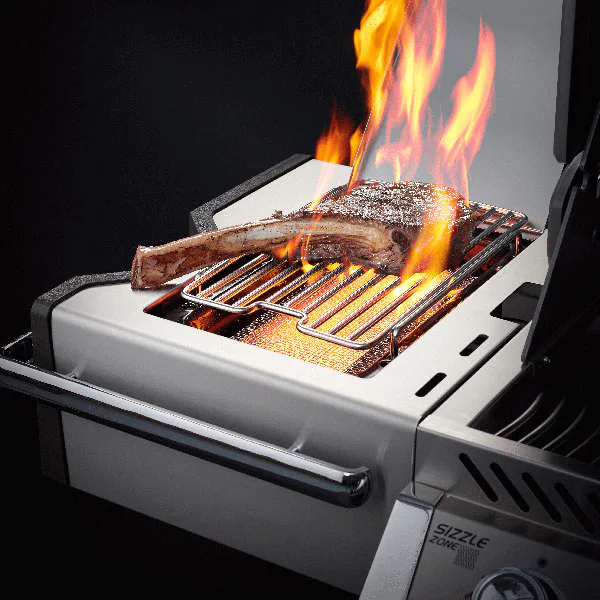
Many Lynx models include an infrared ProSear burner capable of reaching 1,000°F. The ceramic infrared element is extremely sensitive to moisture and cleaning chemical residue. Improper cleaning can cause thermal shock cracking when the burner is next lit.
The Professional Lynx Cleaning Process
- Full disassembly: Grates, ceramic briquette trays, burners, drip system, and grease management components all removed individually.
- Ceramic briquette inspection: Briquettes examined for cracking or saturation. Cleaned or flagged for replacement as needed.
- Burner port clearing: Each ignition port on every burner cleared individually.
- Firebox degreasing and steam sanitization: Food-safe, stainless-appropriate chemistry throughout.
- ProSear element protection: Infrared element isolated from liquid cleaners.
- Grain-direction stainless polishing: Every exterior surface polished in the direction of the steel’s brushed grain.
- Reassembly and full safety check: All burners lit and checked for even flame distribution.
Lynx Grill Cleaning Cost in Bradenton and Sarasota
- Lynx built-in grill cleaning: $360 – $380
- Hood and vent cleaning add-on: $90
- Backsplash and side burner: Included free
A Lynx 36-inch built-in grill retails between $4,500 and $7,000 depending on configuration. Professional cleaning at $360 to $380 every 6 months — roughly $730 per year — is less than 10% of the grill’s replacement cost.
How Often Should a Lynx Grill Be Professionally Cleaned in Florida?
For most Bradenton and Sarasota homeowners, every 6 months is the minimum recommended interval. For grills in high-salt-exposure locations — Siesta Key, Longboat Key, Bird Key, any waterfront property within a mile of the Gulf or bay — we recommend every 4 months.
Get a free quote for your Lynx grill cleaning at xtremegrillclean.com/quote. Mike responds personally to every request within 24 hours.
Ready to book your clean?
Get a ballpark price in under 60 seconds. Mike responds within 24 hours.